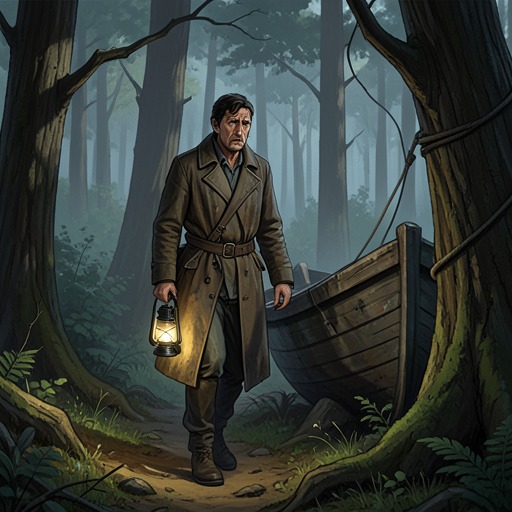
Geppetto carves Pinocchio
The Adventures of PinocchioGeppetto’s carving of Pinocchio turns a common block of firewood into a marionette who appears to possess a will of his own almost from the start. The episode is both a creation scene and the beginning of their troubled bond: Geppetto shapes and teaches the figure, but Pinocchio’s first lesson in movement carries him out of his maker’s reach.
The Piece of Wood and Its Arrival
The story begins not with a king, as the narrator anticipates children might expect, but with an ordinary piece of firewood: a thick, solid log of the kind burned to warm a room in winter. The opening account says that it wept and laughed like a child. Its unexplained arrival in the workshop of Mastro Antonio makes the wood more than passive material before Geppetto ever takes up his tools.
Geppetto receives the piece from Mastro Antonio, thanks him, and limps home with it. His own house is small but neat, with a tiny window beneath the stairway and only an old chair, a rickety bed, and a tumble-down table. A painted fireplace and a painted pot provide the image of warmth and cooking in a room where the furnishings are spare. It is in this modest setting that Geppetto begins to make a companion from the block.
Carving, Naming, and First Signs of Life
Geppetto works on the wood to form a marionette. As he makes its hair, forehead, and eyes, he notices that the eyes move and then stare fixedly at him. He feels insulted by the gaze and addresses the wooden eyes, but receives no answer. The moment leaves the boundary between crafted object and living presence unsettled: the figure’s first sign of animation comes not from Geppetto’s instruction, but from eyes that seem already to look back at their maker.
Geppetto names his creation Pinocchio. He believes the name will bring good fortune, recalling a family of Pinocchios whose richest member still begged for a living. The choice joins affectionate hope to comic irony: the name is meant to promise luck, but the remembered example offers no assurance of prosperity. Naming gives the figure a distinct identity even as Geppetto continues to make him by hand.
A First Lesson That Ends in Escape
When Geppetto puts Pinocchio on the floor, the marionette’s legs are stiff and he cannot move them. Geppetto holds his hand and demonstrates how to place one foot after the other. Once his legs loosen, however, Pinocchio walks by himself, runs around the room, leaps through the open door, and flies into the street. The lesson succeeds physically but not as an act of control: the movement Geppetto teaches immediately becomes the means of escape.
Geppetto runs after him but cannot catch him. Pinocchio’s wooden feet beat loudly on the stones, while passersby stop to stare and laugh at the sight of a marionette running like the wind. His first public appearance is therefore not a planned performance but a flight that turns his newly made body into a spectacle. The scene establishes a pattern that will recur when the Marionettes recognize him at the Marionette Theater: Pinocchio is at once a crafted figure and an independent presence whom others watch, handle, or claim as one of their own.
The Creation’s Lasting Significance
The carving supplies the physical form through which Pinocchio’s later adventures unfold, but it does not make him obedient. Even as Geppetto teaches him to walk, the marionette’s first decisive act is to leave the house. The contrast gives the episode its central consequence: creation begins a relationship, not command over the created figure.
Later, Pinocchio’s body is displayed and interpreted by others in changing ways. At a circus performance, he recognizes the Fairy in a box by the medallion around her neck, which bears the picture of a marionette. That image recalls the wooden identity established in Geppetto’s workshop even after Pinocchio’s body has passed through other forms and public roles. The original act of carving thus remains the basis of his recognition as Pinocchio, while his first escape already shows that his story will concern the struggle between being made and choosing how to move.